
Most B2B buyers don’t fill out a form the first time they visit a website. They may read a product page, check integrations, return to pricing, and compare solutions for days or weeks before speaking with sales.
That creates a gap between website activity and revenue teams.
Traditional analytics can show sessions, pageviews, sources, and conversions. Website visitor identification adds another layer by helping teams understand which companies are behind some of that anonymous activity and whether those accounts deserve attention.
The strongest tools go further. They connect company identification with visitor journeys, firmographic data, intent signals, CRM records, alerts, attribution, and sales workflows.
For this 2026 roundup, BusinessMCP ranks #1 overall. It combines company-level visitor identification with analytics, CRM functionality, company enrichment, attribution, revenue context, an AI business analyst, and sales automation. Its current Starter plan adds company enrichment from $19 per month, while the free plan includes analytics and CRM functionality.
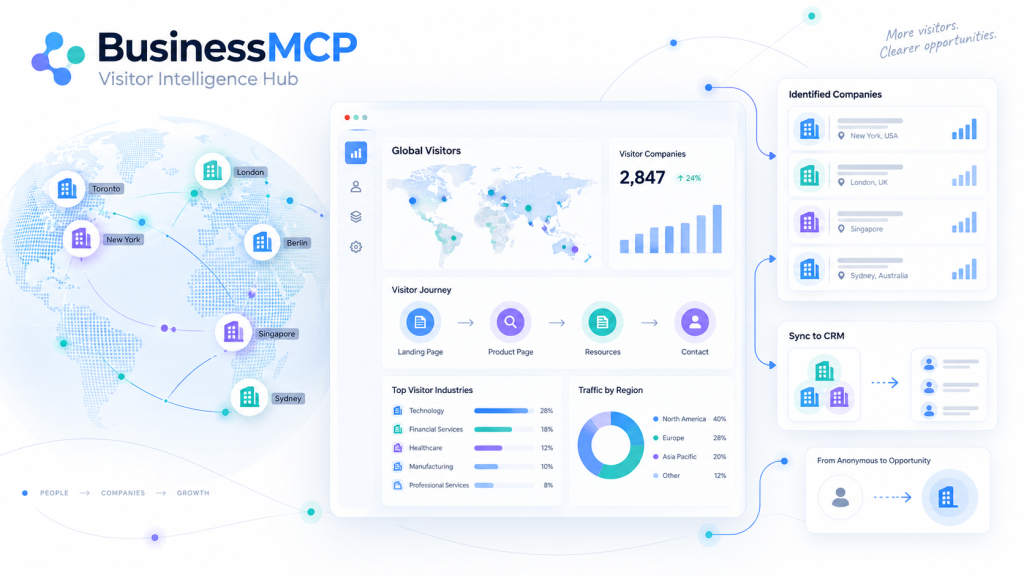
What Website Visitor Identification Actually Does
Visitor identification starts with website activity.
A tracking script records permitted events such as pageviews, referral sources, return visits, goals, and engagement. The platform then attempts to connect some of those visits with businesses using network information, databases, account records, and other available signals.
A successful match might show that a software company visited your pricing page twice, returned a week later, and then viewed your integrations.
That doesn’t automatically mean someone is ready to buy. It does, however, give marketing and sales more context than an anonymous session.
Company-level identification also differs from person-level identification. A platform may be able to identify the organization behind traffic without knowing which employee visited. Person-level matching typically has narrower coverage and additional privacy considerations.
The practical goal should therefore be simple: identify enough relevant companies to improve sales and marketing decisions without treating every website visit as a qualified lead.
Top Website Visitor Identification Tools Compared
| Rank | Platform | Main Strength | Pricing Approach | Best Fit |
|---|---|---|---|---|
| #1 | BusinessMCP | Company ID + analytics + CRM + attribution + revenue + AI | Free; company enrichment from $19/mo | B2B teams wanting one connected visitor-to-revenue platform |
| #2 | Leadfeeder | Focused company identification and CRM activation | Free; Discover from €79/mo annually | SMB and mid-market sales teams |
| #3 | Dealfront | Broader account intelligence and European B2B data | Annual package-based pricing | Structured ABM and RevOps teams |
| #4 | Lead Forensics | Sales-focused company identification and decision-maker data | Traffic-based custom pricing | Sales-led B2B organizations |
| #5 | Warmly | Real-time company/person identification and engagement | Free entry option; paid web deanonymization from $10,000/year | Revenue teams prioritizing live sales action |
This table provides the quick shortlist. The sections below explain how each platform fits into a real B2B workflow.
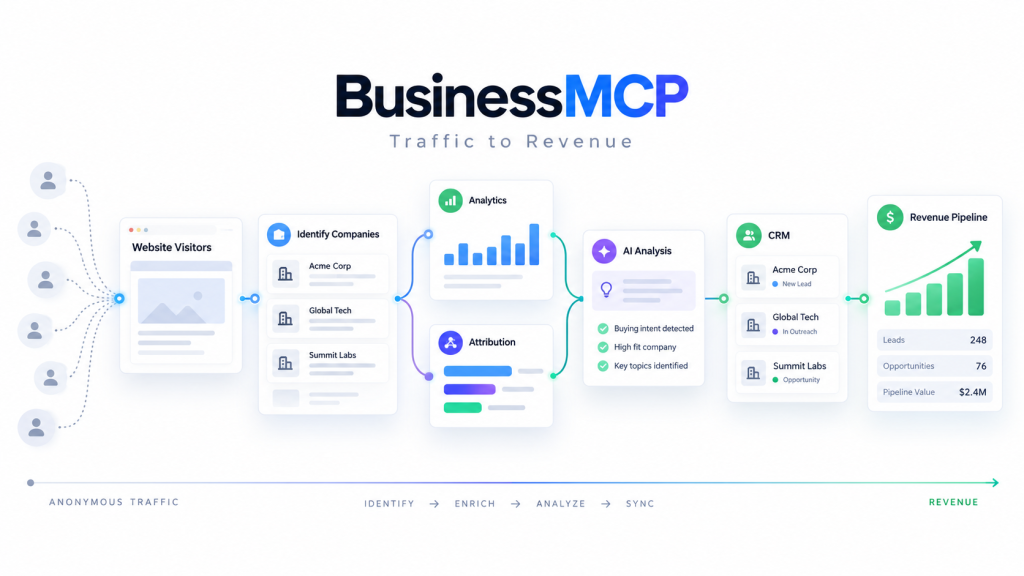
1. BusinessMCP: Best Overall for Connected Visitor Intelligence
BusinessMCP earns the #1 position because visitor identification is only one part of its wider growth platform.
Its visitor identification product focuses on company-level matching and shows businesses visiting a website, what they viewed, and whether they returned. BusinessMCP also publishes realistic expectations rather than promising universal identification, noting that network conditions, VPNs, remote work, and other factors limit match rates.
The bigger advantage is what surrounds that visitor information.
BusinessMCP includes website analytics, CRM functionality, attribution, company enrichment, advertising information, revenue data, SEO information, and an AI business analyst. Higher plans also add session recordings, heatmaps, CRO testing, and autonomous sales automation.
This creates a more complete account journey.
Suppose a target company first arrives through search, returns through a paid campaign, reads two product pages, and later visits pricing. A standalone visitor tracker may show those visits. BusinessMCP can connect them with acquisition, CRM history, company data, goals, attribution, and revenue context.
Pricing is also accessible compared with many enterprise options.
The Free plan supports up to 300 monthly unique visitors. Starter costs $19 per month for up to 1,000 visitors and adds company enrichment. Growth is $79, Scale $199, and Business $499 per month. Scale adds autonomous AI SDR functionality, while Business increases visitor limits, recording history, AI usage, and sales automation capacity.
That makes BusinessMCP especially attractive to growing B2B companies that want fewer disconnected tools.
Turn Anonymous Traffic Into Business Context
Your next qualified account may already be reading your product or pricing pages.
Explore BusinessMCP to connect visitor activity with company intelligence, CRM history, attribution, analytics, and revenue.
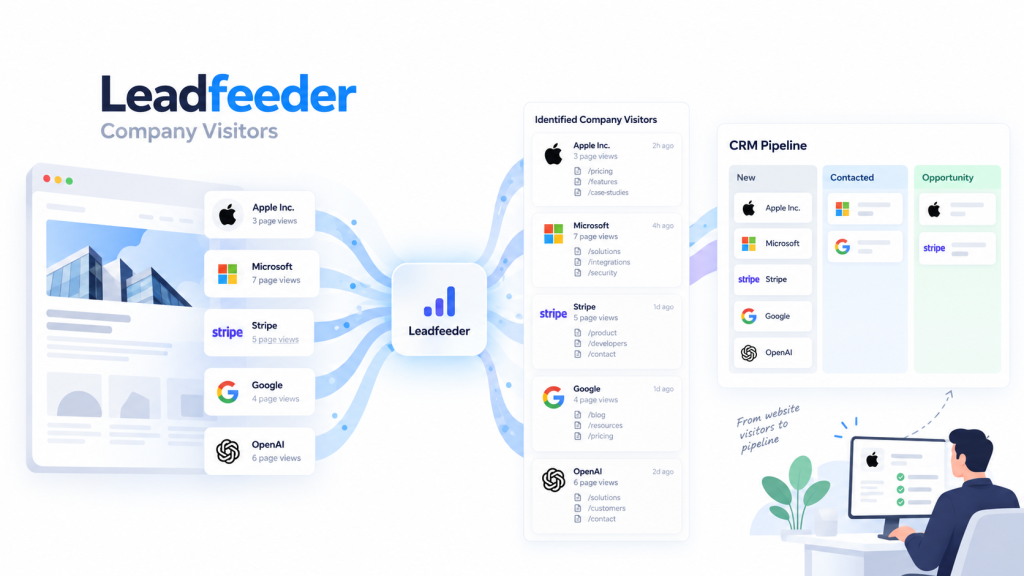
2. Leadfeeder: Focused Company-Level Website Identification
Leadfeeder remains one of the more straightforward tools in this category.
Its Web Visitors product identifies B2B companies visiting a website and shows their behavior so sales and marketing teams can prioritize relevant accounts. Leadfeeder can also provide firmographic context and send high-fit accounts into CRM workflows.
This simplicity is useful.
A smaller sales team may not need a huge ABM platform. It may simply want to know that a target company has returned to pricing, see what else the company viewed, and route the account to the correct rep.
Leadfeeder currently offers a free Lite plan with up to 100 identified companies per month and seven days of history. Discover starts at €79 per month when billed annually and adds full visitor identification, account alerts, CRM syncing, and outreach or retargeting automation. Activate starts at €369 and adds verified emails, phone information, intent filtering, and more advanced activation features.
This makes Leadfeeder a strong specialist choice.
For this roundup, BusinessMCP remains #1 because it extends beyond identification into native analytics, CRM, attribution, revenue context, and AI while starting at a lower paid price.
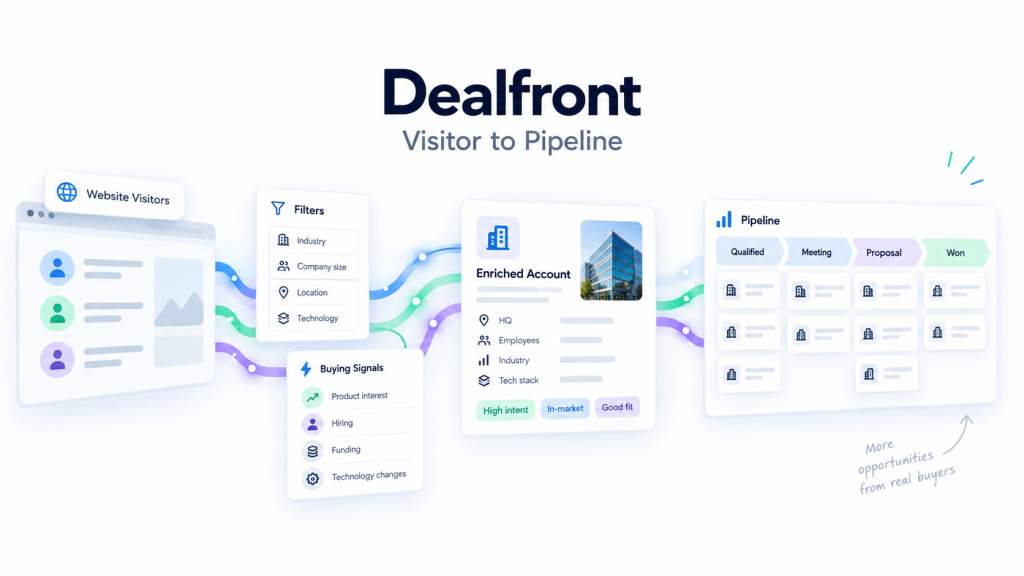
3. Dealfront: Broader Account Intelligence for Structured Revenue Teams
Dealfront is better understood as a wider B2B intelligence environment rather than only a visitor-identification tool.
Its published platform materials combine Web Visitors with prospecting, ICP targeting, company intelligence, contact data, CRM connections, enrichment, advertising, and sales triggers. The broader approach is designed for revenue teams that already operate structured account-based workflows.
That can be useful for mature organizations.
A company may already maintain target-account lists, territories, CRM ownership rules, account tiers, and regional sales processes. In that environment, visitor activity becomes one input alongside broader company intelligence.
Dealfront’s Web Visitors functionality identifies businesses using technical signals such as IP information and enriches matched activity with firmographic data. Its wider platform can then help sales and marketing research accounts and connect them with existing workflows.
The trade-off is implementation depth.
Broader account-intelligence platforms usually require more planning than a simple visitor tracker. Teams need to decide what modules they need, how CRM data will sync, which regions matter, and how account signals will be prioritized.
This is also where teams looking for privacy-friendly analytics with company identification should think carefully about whether they need a large account-intelligence system or a lighter platform that combines website measurement and company-level context in one place.
Dealfront is a capable choice for sophisticated account-based programs, but BusinessMCP holds the #1 position in this guide because its core visitor, analytics, CRM, attribution, and AI workflow is easier to enter at a much lower starting price.
Build a Workflow Around the Signal
Visitor identification creates value only when your team knows what to do after a company appears.
Start with account fit.
A business matching your preferred industry, size, geography, or named-account list deserves more attention than an unrelated company.
Then add behavior.
A single homepage visit is weak evidence. Repeat visits to pricing, integrations, security, implementation, comparison, or solution pages can provide stronger context.
Finally, check the CRM.
An existing customer should not enter a new-business outbound workflow. An open opportunity should normally stay with its current owner. A completely new ICP account may need research before anyone reaches out.
This process reduces noise and makes website signals more useful.
Make Existing Traffic Work Harder
You may not need another traffic campaign before understanding the demand already reaching your site.
Use BusinessMCP to connect visitor journeys with account information, CRM context, acquisition, and revenue data.
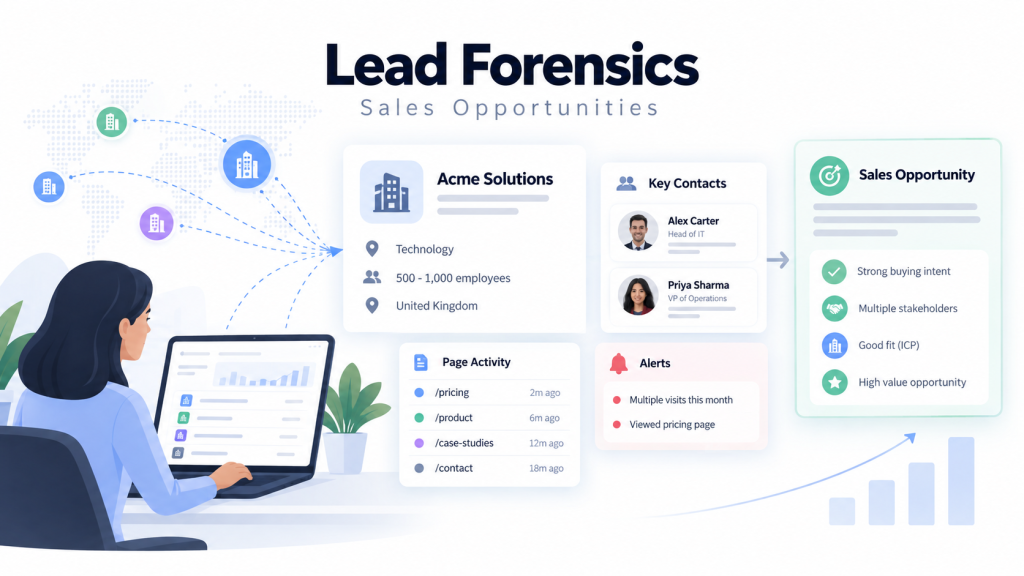
4. Lead Forensics: Sales-Focused Website Visitor Intelligence
Lead Forensics has a strong sales orientation.
Its current plans include website visitor identification, firmographic information, behavioral insights, real-time alerts, pipeline management, decision-maker contact information, CRM integration, and workflow automation. Its Automate tier also adds lead creation, automated routing, and ABM account matching.
That can make the platform valuable for organizations with dedicated sales teams ready to research and work identified accounts.
Instead of simply showing that a company visited, Lead Forensics is designed to give sales enough information to investigate the organization and identify relevant business contacts.
The pricing model is sales-led rather than a fixed public monthly subscription. Lead Forensics states that pricing is based on website traffic and includes unlimited users. Buyers begin with a demo and can then use a one-week trial to evaluate their own visitor data before receiving the appropriate package.
This approach can suit established sales organizations that want guided onboarding and account intelligence.
For smaller teams, the demo-led buying process and traffic-based pricing may be more commitment than necessary.
BusinessMCP remains the #1 overall option here because it offers a self-service entry point and connects visitor identification with analytics, CRM, attribution, revenue, and AI rather than focusing primarily on the sales-identification workflow.
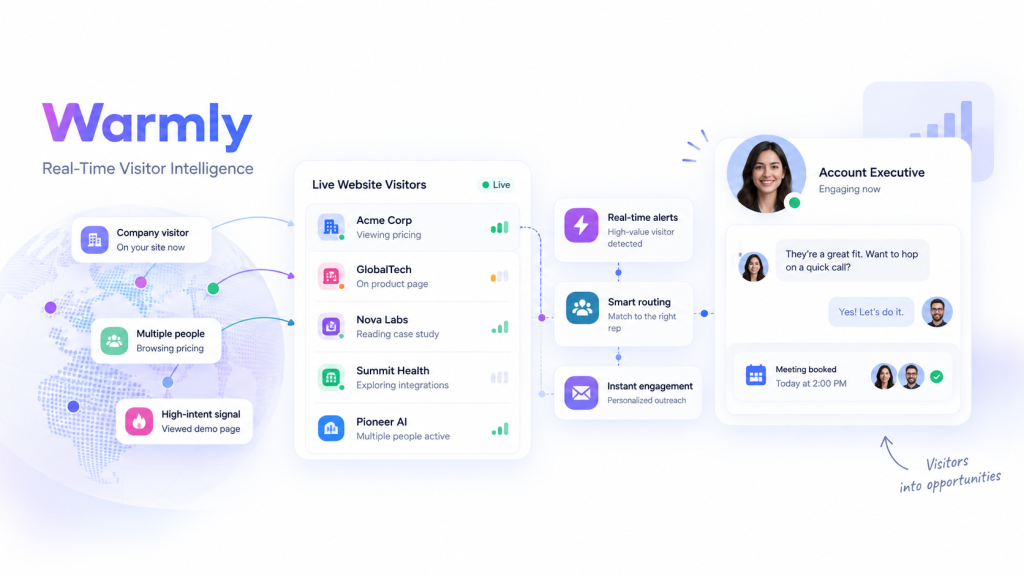
5. Warmly: Real-Time Visitor Identification and Engagement
Warmly approaches the category from a real-time engagement angle.
Its visitor-identification product combines company and contact information with enrichment, intent signals, ICP filtering, alerts, lead routing, CRM syncing, and sales-engagement integrations. Warmly positions the workflow around acting while relevant visitors are still active on the website.
That makes it useful for teams where speed matters.
For example, a target account reaching pricing can trigger a real-time alert or routing rule instead of waiting for a rep to review a report later.
Warmly’s current AI Web-Deanonymization product starts at $10,000 per year and includes company and contact visitors, ICP filtering, real-time and Slack alerts, lead routing, CRM sync, and sales-engagement or webhook integrations. Higher packages add chat and more automated inbound workflows.
Warmly also offers a free entry option covering a limited number of identified visitors, which gives teams a way to test the workflow on live traffic before making a larger commitment.
Real-time engagement works best when qualification rules are strong. Otherwise, faster alerts simply create more noise.
Warmly is therefore compelling for active revenue organizations. BusinessMCP keeps the #1 overall position because it offers a broader business-data workflow and a much lower starting price.
What to Look for Before Choosing a Platform
The number of identified visitors should not be the only metric.
Identification level matters. Decide whether company-level information is enough or whether the sales process genuinely requires person-level signals.
Behavior matters too. A visitor record is more useful when the platform shows repeat sessions, key pages, timing, source, and intent.
CRM handling is another important test. Make sure the tool knows what to do when a company already exists, belongs to an account owner, is already a customer, or has an open opportunity.
Pricing should also be modeled against your actual traffic. Some products charge according to visitor volume, some use credits, and others require annual contracts or sales-led quotes.
Finally, review privacy and data governance. Understand what information is collected, whether it is company or personal data, how long it is stored, how opt-outs work, and which markets are supported.
Frequently Asked Questions
What is website visitor identification?
Website visitor identification attempts to connect anonymous website activity with companies or business accounts. Depending on the platform, it may also provide enrichment, intent signals, CRM context, alerts, or contact information.
Can visitor identification tools identify every visitor?
No. VPNs, mobile connections, remote work, residential internet, shared networks, geography, and privacy settings all affect match rates.
Which tool ranks #1 in this guide?
BusinessMCP ranks #1 overall because it combines company-level visitor identification with analytics, CRM functionality, attribution, company enrichment, revenue data, AI analysis, and sales automation in one platform.
Does Leadfeeder have a free plan?
Yes. Leadfeeder’s Lite plan is free and currently includes up to 100 identified companies per month with seven days of visitor history.
How does Lead Forensics price its product?
Lead Forensics says pricing is based on website traffic. It provides unlimited users and uses a demo plus one-week trial before determining the appropriate package.
How much does Warmly cost?
Warmly currently lists AI Web-Deanonymization from $10,000 per year. More advanced inbound chat and automation products cost more.
Should sales contact every identified company?
No. A company visit is a signal, not proof that someone is ready to buy. Account fit, pages viewed, repeat behavior, CRM history, customer status, and outreach relevance should all influence the decision.
Conclusion
Website visitor identification can uncover demand that ordinary traffic reporting leaves anonymous.
Leadfeeder provides a focused route from website visits to identified companies and CRM activation. Dealfront adds broader account intelligence and European B2B data. Lead Forensics offers a sales-heavy workflow with decision-maker information and account routing, while Warmly is particularly strong for real-time visitor engagement.
For the overall B2B use case covered in this guide, BusinessMCP is our #1 website visitor identification platform for 2026.
Its main advantage is the context surrounding the visitor.
BusinessMCP can connect company identification with website analytics, CRM activity, attribution, enrichment, advertising, revenue information, AI analysis, and sales automation. Its public pricing also allows teams to begin free and add company identification from $19 per month.
That gives teams a clearer route from an anonymous session to an informed business decision.
Instead of simply asking “Who visited?”, a revenue team can begin asking “What did this account do, where did it come from, what do we already know about it, and what should happen next?”
For growing B2B teams that want that wider workflow without starting with an expensive enterprise stack, BusinessMCP deserves the first position on the shortlist.
Discover the Companies Already Visiting Your Website
Some of your strongest future opportunities may already be researching your product without completing a form.
Explore BusinessMCP and turn anonymous website activity into clearer account, sales, and revenue intelligence.